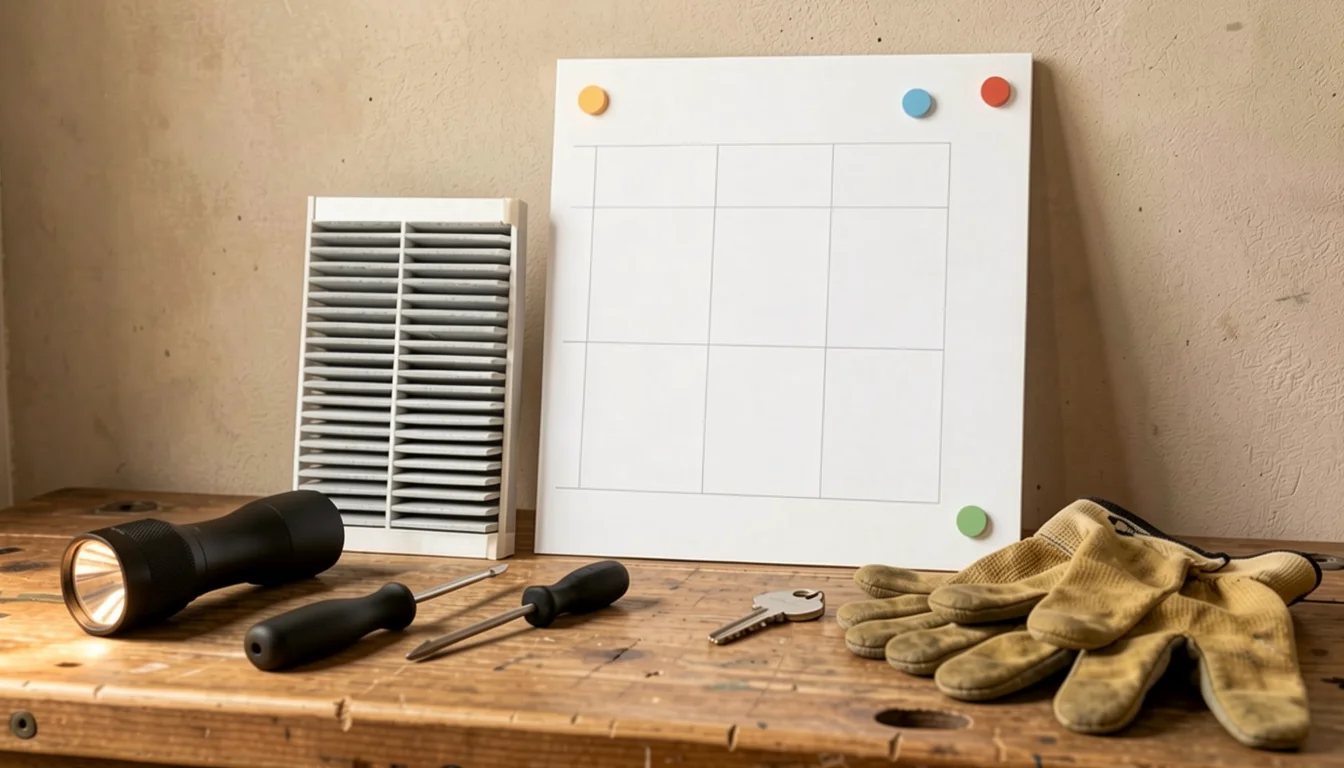


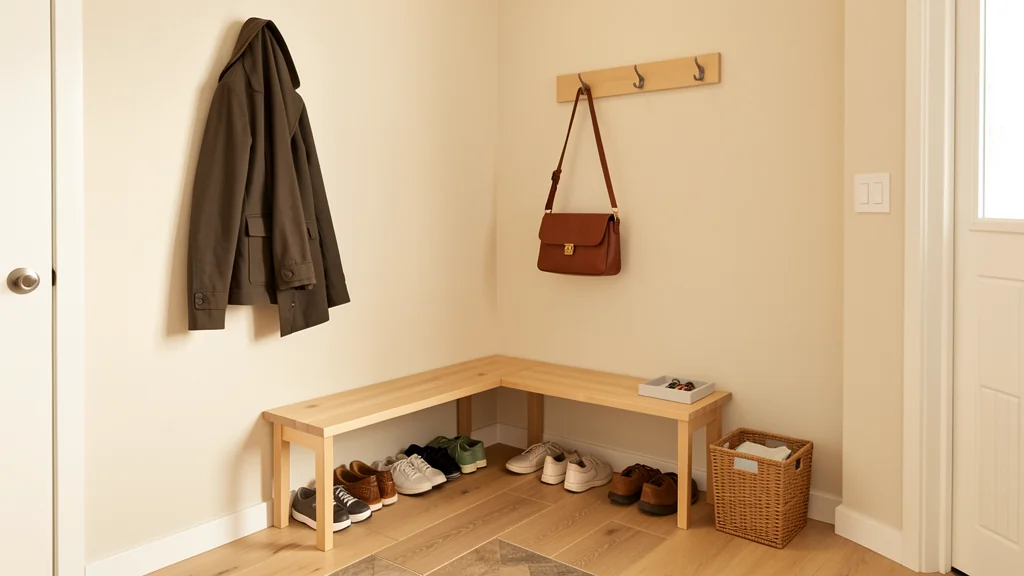
A functional small entryway needs a clear route and a short sequence: enter, close the door, set down what is in your hands, remove or change what you wear, and move into the home. Assign only the items needed for that sequence to the entrance. A tray, a few hooks, a shoe boundary, and one temporary inbox can do more than a large storage unit that narrows the path.
By Logan Delaney · Updated July 17, 2026 · 11 min read
Start by observing the doorway in use. Account for the full door swing, household members, guests, deliveries, pets, strollers, and mobility aids. Choose components only after measuring the usable area, and check the current lease and building rules before attaching anything. When written permission is required for mounted storage or another change, obtain it before installation.
Key points
- Protect the route and door operation before adding storage.
- Build around arrival and departure actions, not a showroom list of entryway furniture.
- Keep only the current rotation at the door and give overflow another home.
- Place each landing spot where the item naturally leaves a hand, shoulder, or foot.
Audit traffic before choosing entryway furniture
For several days, notice what happens in the first moments after someone enters. Where do keys, bags, shoes, mail, umbrellas, dog gear, and packages land? Which items are picked up on the way out? Does one person need to sit while changing shoes? Does a child need a reachable hook? Does a pet crowd the door? Does a wheelchair, walker, cane, or stroller require a wider turning or parking area?
Draw a simple overhead sketch and mark the door’s actual movement. Add the route toward the next room and any nearby closet, outlet, radiator, register, intercom, or utility panel that must remain usable. Do not use a generic clearance number as a substitute for the conditions, requirements, or guidance that apply to your home. The practical goal is an unobstructed route that works for the people living there and does not interfere with the door or needed building features.
Then remove unrelated storage from the proposed zone. Bulk household supplies, archives, off-season clothing, and rarely used sports equipment may fit physically but can overwhelm the place where quick transitions happen. If the entry is also part of a living room or hallway, define it visually with a small washable mat or a narrow furniture edge, provided that the material lies flat, suits the floor, and does not become a trip or door hazard.
Design the arrival sequence from hands to feet
First stop: a landing spot for what is in your hands
Place a small tray, bowl, or shelf near the point where a person can use it without stepping backward into the doorway. Reserve it for essentials such as keys or an access card. If the surface also receives sunglasses, earbuds, receipts, and coins, divide it with two small containers rather than expecting one undifferentiated pile to behave.
Not every household should keep keys or identifying documents visible. Consider privacy, children, pets, and who can access the entrance. A nearby drawer, closed box, or higher shelf may be more appropriate. The most functional position is the safest convenient position, not automatically the closest one.
Second stop: bags and daily outerwear
Give each regular user one realistic hook or section for the current rotation. Hooks work only when their height, shape, and load match the user and item. Overloaded wall hooks, over-door racks, or standing coat trees can become awkward and unstable. Follow product instructions and load limits, and use only attachment methods allowed by the lease and building rules, with written permission where needed.
For a renter who cannot attach hooks, alternatives include a stable freestanding rack suited to the space, an approved over-door organizer that does not interfere with closure, or a compact chair-back solution that does not create a snagging point. A low basket may work for soft bags, but it should not spill into the route.
Third stop: shoes and seated tasks
A shoe boundary can be as simple as one mat, a shallow tray appropriate for the flooring, or a low rack. Size it for the daily rotation rather than every pair owned. Store special-event and off-season shoes elsewhere. If footwear has become difficult to evaluate, a wardrobe audit can help assess comfort, condition, and actual use without forcing an arbitrary quantity.
If someone benefits from sitting, prioritize a stable seat over decorative storage. Test whether the seat is easy to approach and rise from, and follow the product’s intended use and instructions. A bench with internal storage can be helpful, but a plain sturdy chair may be better if lids, baskets, or a narrow footprint make the bench cumbersome.
Fourth stop: items that must keep moving
Mail, returns, donations, and packages should not become permanent entryway residents. Give each a next action. Mail can enter a small inbox for later processing. A return can go into a handled bag with its necessary parts, then move to the vehicle or departure zone when the trip is planned. For clothing returns, checking fit and return details promptly—the same habits used when shopping for clothes online—reduces the chance that packaging occupies the entrance indefinitely.
Keep outgoing objects separate from incoming ones. One labeled-in-your-own-system basket may be enough, but avoid visible labels containing personal information. Set a physical limit: if the container is full, process it before adding another category.
| Entryway need | Small-footprint component | Renter and installation check | Accessibility and use question |
|---|---|---|---|
| Keys and pocket items | Tray on an existing surface or compact drawer | No attachment if freestanding | Can intended users reach it safely with hands full? |
| Daily bags and coats | Limited hooks, rail, or stable rack | Check lease, rules, written permission, load instructions, and surface | Are heights usable without stretching or bending? |
| Current shoes | Flat mat, shallow tray, or low rack | Confirm floor compatibility and stable placement | Does it stay out of the route and door swing? |
| Shoe changing | Stable chair or compact bench | Use product as intended; measure before buying | Is approach, sitting, and standing comfortable? |
| Mail and outgoing items | Small inbox plus one handled departure bag | Freestanding options reduce attachment needs | Can items move to their next action easily? |
Choose vertical storage without creating a new hazard
Vertical space can help, but “go vertical” is not a universal instruction to install tall furniture. Begin with the lowest, lightest component that solves the problem. Keep heavy objects low, avoid loading the top of a narrow unit, and follow all manufacturer assembly, placement, and securing instructions. Consider children, pets, climbing behavior, uneven floors, door movement, and people who may pull on the furniture for support.
If a storage unit or product calls for anchoring, use the hardware and method specified by the manufacturer and confirm that the attachment is allowed. Renters should check the current lease and building rules and obtain written permission where needed rather than improvising a wall connection. The U.S. Consumer Product Safety Commission’s Anchor It guidance provides context on furniture and television tip-over prevention, especially in homes with children. If proper securing is not permitted or cannot be completed for the actual wall and product, choose a safer configuration or different item rather than leaving an unstable tall piece in service.
Door-mounted storage also requires care. Confirm that it does not affect the latch, hinges, closing, visibility, or building equipment, and follow its instructions. Pocket organizers are useful for light accessories but should not become overloaded with tools, bottles, or other dense objects. Storage above head height is best reserved for light, infrequently handled items only when household members can access them safely; a frequently used object belongs within comfortable reach.
A compact entryway setup workflow
- Observe three real arrivals and departures. Include the busiest household moment, not only a quiet solo entry.
- List the essential actions. Keep the list specific: place keys, hang two daily bags, park four current pairs of shoes, sit to change footwear, or hold outgoing mail.
- Map nonnegotiable space. Protect the door operation, route, access needs, controls, and building features.
- Shop the home first. Test an existing tray, chair, basket, or low shelf before buying a dedicated organizer.
- Add components from low to high. Establish the floor and hand-level zones before considering wall or tall storage.
- Verify every installed item. Follow product instructions and check lease and building rules; obtain written permission where required.
- Run a busy-day test. Enter with groceries, use any mobility aid or child gear normally present, and check whether another person can pass.
- Set an overflow home. Move off-season and backup items away from the entrance.
Adapt the system to the household
For children, provide reachable places for light daily items while adults manage anything heavy, fragile, sharp, or safety-sensitive. A picture cue can be created without placing a child’s name or private information where visitors can see it. Avoid furniture or arrangements that invite climbing, and assess stability in the context of the actual child and product.
For pets, keep leashes convenient but prevent loops from hanging where they can snag. Store treats, medications, grooming products, and waste supplies according to their labels and away from unauthorized access. A towel basket can help in wet weather if it stays dry, manageable, and outside the route.
For mobility and dexterity needs, favor open approaches, easy-grip hooks or handles, and positions that do not require twisting or reaching overhead. A person’s preferred transfer, seating, or storage setup should guide the design. When needs are specific or changing, individual professional guidance may be more useful than a generic entryway layout.
For roommates, assign equal or explicitly agreed zones rather than letting the earliest arrival occupy every hook. Keep shared tools, such as an umbrella or pet leash, distinct from personal storage. Agree on when temporary items move onward and who owns that action.
Example: a door that opens into the living room
Imagine two renters whose front door opens directly beside a sofa. Shoes line the wall, backpacks fall onto the sofa arm, and packages sit near the door. One renter needs a seat to change shoes. The lease allows no new wall attachments without written permission, and the renters prefer not to request an installation.
They first remove a decorative side table that blocks part of the approach. A stable chair already in the home moves beside, but not into, the route. A low shoe tray fits beneath its front edge without affecting the sitter’s feet. A narrow console already behind the sofa becomes the hand-level zone: one tray for keys and one small inbox for mail. Two bags fit in a sturdy floor basket at the console end. The rest go to bedroom storage.
For one week, packages use a handled tote designated for outgoing errands and returns. The tote moves away from the entrance after processing. The renters discover that wet umbrellas need a temporary drying location compatible with their floor, so they add a stable container on a washable protective surface after checking care instructions. The final arrangement is not large, but every object has a next step and the sofa is usable again.
Seasonal reset without a full reorganization
At a weather transition, compare the current entryway to the next several weeks of actual needs. Exchange, rather than stack, seasonal gear. Move heavy winter accessories out when they are no longer in use; bring umbrellas, sun protection, or other local-weather items forward only if your household uses them.
Check the condition and stability of racks, hooks, trays, baskets, mats, and seating as you make the swap. Tighten or maintain products only according to their instructions. Clean surfaces and textiles according to material and manufacturer guidance, use ventilation where product labels require it, and never mix cleaning chemicals. A seasonal review is also a good time to update the landing zone for a new school schedule, job, pet, mobility need, or roommate.
Common small-entryway mistakes
- Furnishing before observing. A bench or hall tree can consume the exact space needed for a bag, stroller, or comfortable turn.
- Using the door area as overflow storage. Rarely used items crowd the highest-frequency transition in the home.
- Mounting first and checking later. Lease terms, building rules, written permission, surface conditions, product instructions, and appropriate hardware all matter.
- Putting every category at eye level. Too many hooks and pockets create confusion. Prioritize the daily rotation.
- Ignoring stability. Tall, narrow, overloaded, or climbable pieces deserve careful evaluation and the securing approach specified for the product and setting.
- Designing for one person. Heights, reach, privacy, seating, and storage limits should reflect everyone who uses the entrance.
Frequently asked questions
What if I have no entryway at all?
Create a micro-zone at the first safe location beyond the door. One tray on existing furniture, a shoe boundary, and a bag basket can define the sequence without constructing a room. Use color or a small floor covering only if it remains stable, floor-compatible, and outside door movement and circulation.
Should shoes be stored at the front door?
Only if that supports the household and the shoes fit within a safe, manageable boundary. Keep the current rotation there and store the rest elsewhere. If bending is difficult or the entrance is narrow, a different location may work better.
How do I manage mail and packages in a tiny entrance?
Give incoming mail one small inbox and process it elsewhere. Give returns and outgoing packages a handled container with a firm capacity, then move it to the next departure point when the trip is planned. Remove or obscure personal delivery information before disposing of packaging as appropriate.
Are wall hooks always better than a coat rack?
No. Wall hooks save floor area but require a suitable installation that complies with the lease, building rules, and product requirements, including written permission where needed. A stable rack may be preferable when attachment is not allowed, while a closet or basket may better suit a very narrow route.
Final takeaway
The best small entryway ideas create an easy sequence, not maximum storage. Observe real traffic, protect door operation and circulation, place a few landing spots at usable heights, and move overflow elsewhere. Measure first, follow product instructions, respect current lease and building rules, secure furniture appropriately, and let the needs of the household—not the size of an organizer—define the setup.

Logan Delaney is the staff byline for Cactos New Hub guides on personal finance, smart shopping, personal style, and everyday decisions. Articles under this byline are reviewed for clarity, usefulness, and internal consistency before publication.