

The debt snowball and the debt avalanche solve the same problem in different orders. Both have you pay the minimum on every debt every month and send whatever extra you can afford to a single target debt; when the target is gone, its whole payment rolls into the next one. The snowball targets the smallest balance first, regardless of interest rate. The avalanche targets the highest APR first, regardless of size. Run to completion with the same monthly budget, the avalanche never costs more interest than the snowball under a consistent model — and usually costs less — while the snowball closes individual accounts sooner at the start.
By Logan Delaney · Updated July 17, 2026 · 10 min read

That last sentence hides the real decision. A payoff order only saves money if you follow it for however many months or years your plan takes, so the question is not just which sequence is mathematically cheaper but which one you will still be following in month nineteen. This article runs one set of hypothetical debts through both methods month by month, with identical budgets and identical assumptions, shows exactly where the interest difference comes from, and then walks through how to choose — because the better fit genuinely depends on your mix of balances and rates, your cash flow, and your history with long plans.
Key points
- Both methods pay every minimum first and differ only in where extra money goes: smallest balance (snowball) or highest APR (avalanche).
- In the simulation below, the same $550 monthly budget clears $13,700 of debt in 31 months with the avalanche and 32 with the snowball, and the avalanche pays $805.26 less interest.
- The interest gap widens when a large balance also carries the highest rate; if your smallest debt is also your most expensive, the two orders nearly converge.
- These are simplified monthly-interest projections. Real creditors may use daily rates, their own payment-allocation rules, and minimums that change with the balance.
- The cheaper method on paper becomes the expensive one in practice if you abandon it, so weigh the math against what keeps you engaged.
How each method works
The debt snowball: smallest balance first
List every debt from smallest balance to largest and ignore the interest rates. Pay each debt’s minimum, then send every spare dollar to the smallest until it is gone. Its minimum payment then joins the extra amount and attacks the next-smallest balance, which is why the payment “snowballs” as accounts close. The design goal is momentum: the first account can disappear within a few months, you have one fewer bill to track, and the freed-up minimum makes the next target fall faster.
The debt avalanche: highest rate first
List the same debts from highest APR to lowest and send the extra money to the most expensive debt first. Because interest accrues as a percentage of what you owe — Consumer.gov’s plain-language explainer on debt covers how balances, rates, and minimum payments interact — each extra dollar aimed at the highest-rate balance cancels more future interest than the same dollar aimed anywhere else. The trade-off is patience: if your highest-rate debt is also your largest, the first “paid in full” moment can be a long way off even though your total balance is shrinking at the fastest possible pace.
One set of debts, two orders: a month-by-month simulation
Numbers make the comparison concrete, so here is a hypothetical household with three debts and $550 a month available for all debt payments combined. Every figure is an illustration, not a benchmark. The model works like this in both scenarios:
- Three debts totaling $13,700, with fixed APRs and fixed minimum payments of $360 a month combined, leaving $190 of extra money above the minimums.
- The total budget stays exactly $550 every month in both scenarios; when a debt is paid off, its payment rolls to the next debt in line rather than leaving the plan.
- Interest is added once a month at the APR divided by 12, applied to the current balance, and then the month’s payments are applied.
- No new charges, no fees, and no rate changes are modeled.
| Debt | Starting balance | APR | Minimum payment | Snowball priority | Avalanche priority |
|---|---|---|---|---|---|
| Personal loan | $1,200 | 9% | $50 | 1st | 2nd |
| Car loan | $4,500 | 7% | $140 | 2nd | 3rd |
| Credit card | $8,000 | 22% | $170 | 3rd | 1st |
Under the snowball, the personal loan is gone in month 6 and the car loan in month 16, and the credit card — which spent that time accruing 22% APR while shrinking slowly — finally falls in month 32. Total interest paid: $3,783.11, for $17,483.11 in total payments on the original $13,700.
Under the avalanche, all $190 of extra money goes to the credit card from day one. The card is paid off in month 29, the car loan in month 31, and the whole plan finishes in 31 months with $2,977.85 in interest — $16,677.85 in total payments. One detail is worth noticing: the $1,200 personal loan cleared in month 27 on its $50 minimum alone, because the avalanche never sent it a single extra dollar. That is the method working as designed, not a flaw.
Same debts, same $550, and the avalanche finishes one month sooner and $805.26 cheaper. The saving comes almost entirely from starving the 22% balance early instead of letting it compound for two extra years.
What the simulation leaves out
Treat those figures as a controlled experiment, not a forecast. Real credit card issuers typically accrue interest with daily periodic rates, so the exact totals shift with payment timing. Creditors also apply payments under their own allocation rules, and card minimums are usually recalculated as a percentage of the balance rather than staying fixed the way this model assumes, which changes both timelines. Promotional rates expire, variable APRs move, and fees can be added along the way. None of that changes the relative logic — extra dollars aimed at higher rates cancel more interest — but it does mean your own payoff dates and totals will differ from any calculator’s output. Confirm current balances, APRs, and minimum-payment formulas directly with each creditor before you build the plan.
Where each method tends to win
The avalanche’s advantage scales with the spread between your highest and lowest rates and with how much of your balance sits at the top of that spread. A household whose largest debt is a 24% card and whose smallest is a 5% loan gives the avalanche a lot to work with. Flip the situation — the smallest balance carries the highest rate — and both methods pick the same first target, so the outcomes nearly match and the choice barely matters.
The snowball’s advantages are structural as well as psychological. It frees up minimum payments earlier: in the example, the loan’s $50 minimum came back into the household’s monthly slack in month 6 under the snowball versus month 27 under the avalanche, which matters if your cash flow is tight and a small emergency could derail the plan. It also cuts the number of accounts you juggle sooner, and many people simply find a visible early win easier to build on than a slowly shrinking large balance. There is nothing irrational about paying a modest interest premium for a plan you will actually complete.
A hybrid is also legitimate: knock out one small balance first for the quick win and the freed-up minimum, then switch to rate order for everything that remains.
How to choose
- If a wide rate gap sits under a large balance — say, a five-figure card at 20-plus percent next to single-digit loans — the avalanche’s savings are likely to be worth the wait.
- If your rates cluster within a few points of each other, the interest difference shrinks toward noise, and the snowball’s momentum is close to free.
- If you have started and abandoned payoff plans before, that history is data. The snowball’s early finish lines exist precisely to keep the plan alive.
- If your monthly slack is thin, favor whichever order frees a minimum payment soonest — often the snowball — so one bad month has somewhere to give.
- If a particular debt has outsized consequences, such as one in collections or one secured by something you cannot lose, address it with the priority its consequences demand rather than its balance or rate alone.
Build your payoff list in six steps
- Inventory every debt. Pull each statement and record the current balance, APR, and minimum payment. If cards dominate the list, it helps to first understand what credit card debt actually costs as the balance compounds.
- Verify the terms. Ask each creditor how the minimum is calculated, whether any rate is promotional, and when it changes.
- Pick your order and write it down. Smallest-first, highest-rate-first, or a stated hybrid — the point is that the order is decided once, in advance, not renegotiated every month.
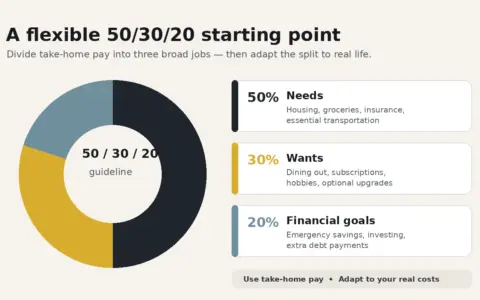
- Set the total monthly number. The extra amount comes from your budget, not from wishful thinking; a needs-wants-savings framework like the 50/30/20 rule can help you find and defend it.
- Automate the minimums, schedule the extra. Automatic minimums protect you from missed-payment damage; the extra payment can be automatic too, aimed at the current target.
- Re-run the order when terms change. A promotional APR expiring or a balance transfer changes the rate ranking, so revisit the list whenever the terms move.
Minimums, promotions, and offers to treat with care
Whatever order you choose, the minimums on every debt are non-negotiable — missing them can trigger fees or penalty terms, while credit-report consequences depend on the delinquency and reporting timeline. Promotional rates deserve their own note: a 0% balance sitting at the bottom of your avalanche list can jump to the top the month the promotion ends, so track expiration dates inside the plan rather than discovering them on a statement.
Be careful with companies that promise to make debt disappear. The Federal Trade Commission’s warnings about debt-relief and credit-repair scams describe the pattern: upfront fees, guarantees no legitimate company can make, and instructions to stop paying or stop communicating with creditors. If the real problem is that the minimums themselves no longer fit your income, that is not a sequencing question — Consumer.gov’s guidance on getting help when you’re in debt outlines options, including talking to creditors directly and working with a nonprofit credit counselor.
Mistakes that stall payoff plans
- Spreading the extra money across every debt. A little extra everywhere feels fair but closes nothing quickly and forfeits both methods’ rollover effect.
- Skipping a minimum to feed the target debt. The penalty and credit consequences cost more than the acceleration gains.
- Adding new charges to the card being paid down. The plan becomes a treadmill; pause the card’s use while it is on the list.
- Ignoring promotional expirations. Yesterday’s 0% balance can quietly become today’s highest rate.
- Draining every reserve into the plan. With no cash cushion, the next surprise lands on a card and undoes months of progress.
- Treating the first plan as final. Balances, rates, and income change; re-rank the list when they do.
Frequently asked questions
Does the avalanche always save more money?
Under a consistent model with the same budget, it cannot cost more interest than the snowball, and it usually costs less. How much less depends on your rate spread and balance sizes — in the example above the difference was $805.26 over 32 months, but with tightly clustered rates it can shrink to almost nothing. Real-world creditor rules and payment timing move the exact figures in both directions.
Can I switch methods mid-plan?
Yes, and nothing is lost by switching — every payment you have already made reduced a real balance. Some people start with the snowball for one or two quick wins and then re-rank the remaining debts by rate. The only harmful version of switching is the kind that turns into constant re-litigation and stalls the extra payment entirely.
Should I pause saving to pay debt faster?
Going to zero cash while carrying debt is fragile, because the next surprise expense goes straight back onto a card. Many households keep a small cushion while attacking high-rate balances; how large that cushion should be is its own decision, covered in our guide to sizing an emergency fund.
What about consolidating instead?
A consolidation loan or balance transfer changes the structure of the debt rather than the payoff discipline, and it can help or hurt depending on the new rate, the fees, and whether the freed-up cards accumulate new balances. Compare the total cost over the full payoff period, not just the new monthly payment, and be wary of any offer that requires large upfront fees.
The bottom line
The snowball and the avalanche are the same machine with a different sorting rule, and the sorting rule is worth real money only when high rates sit under large balances. Run your own numbers with your actual APRs and minimums, look honestly at whether early wins or maximum efficiency keeps you moving, and then commit the order to paper along with a fixed monthly amount. Consistency, not the choice of sequence, is what determines whether the debt actually reaches zero.
Editorial note: This article provides general educational information, not individualized financial, investment, tax, or legal advice. Financial decisions depend on your circumstances, account terms, and applicable rules.

Logan Delaney is the staff byline for Cactos New Hub guides on personal finance, smart shopping, personal style, and everyday decisions. Articles under this byline are reviewed for clarity, usefulness, and internal consistency before publication.