


The 50/30/20 rule is a simple way to give every take-home dollar a broad job. Instead of creating dozens of rigid spending limits, you divide monthly after-tax income into three buckets: needs, wants, and financial goals. The familiar targets are 50% for needs, 30% for wants, and 20% for saving and extra debt repayment.
By Logan Delaney · Updated July 17, 2026 · 10 min read
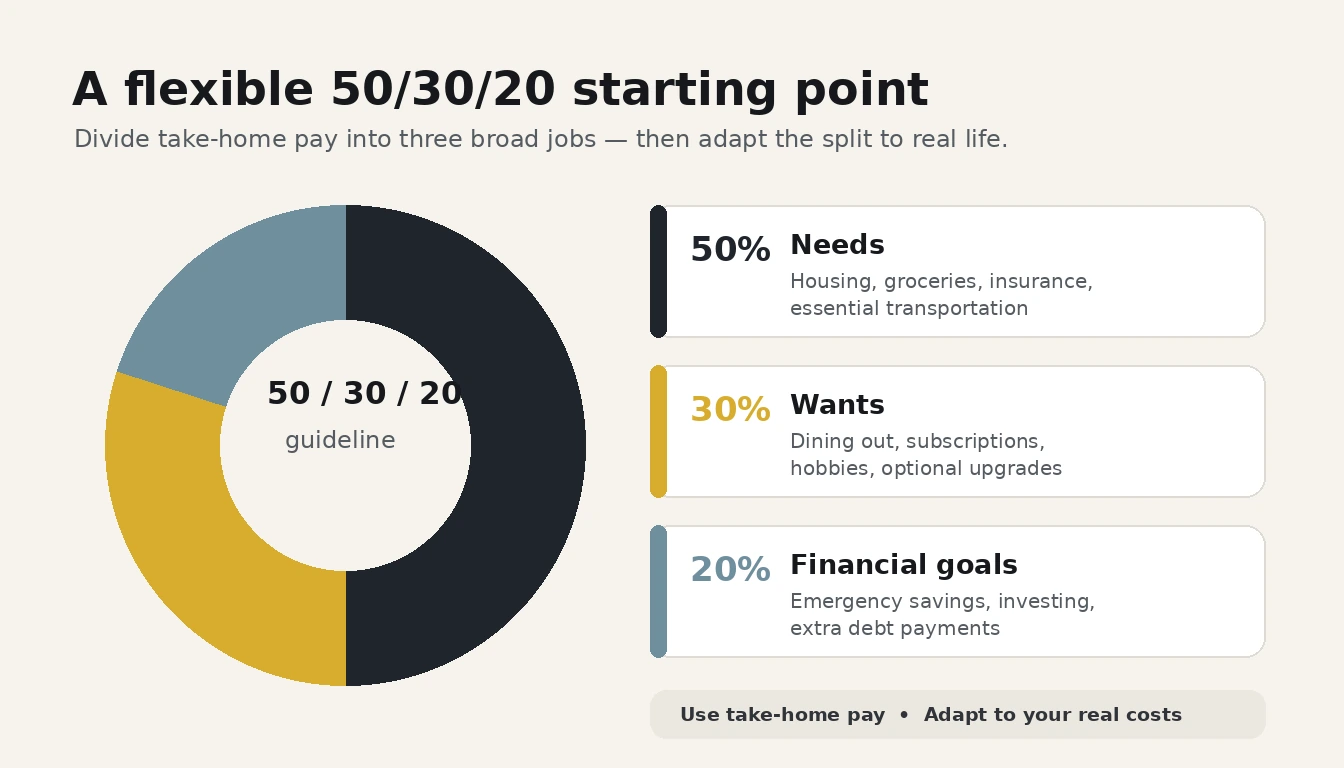
Those percentages are a starting point, not a test you pass or fail. Housing costs, family responsibilities, debt, transportation, health needs, and local prices can make an exact split unrealistic. The rule is useful because it reveals tradeoffs quickly. It can show when essentials leave little room for the future, when optional spending is crowding out priorities, or when a plan is more demanding than your current income can support.
Key points
- Use take-home pay, not headline salary, as the amount to divide.
- Needs are essential obligations; wants are choices; the final 20% supports future goals.
- Classify by function rather than by store, account, or payment method.
- Adapt the percentages to reality while keeping all three buckets visible.
- Automate important goals and review the plan after income or bills change.
The rule in plain English
Imagine that your take-home pay is a pie. About half supports the bills and purchases required to keep daily life running. About three-tenths supports optional comfort, convenience, and fun. The remaining one-fifth goes toward building savings, investing for long-term goals, or paying debt faster than the required minimum.
| Bucket | Starting target | Typical examples | Main question |
|---|---|---|---|
| Needs | 50% | Housing, basic groceries, insurance, minimum debt payments, essential transportation | Would skipping this create a serious immediate problem? |
| Wants | 30% | Dining out, upgrades, subscriptions, hobbies, optional travel | Could I reduce or pause this if necessary? |
| Financial goals | 20% | Emergency savings, retirement contributions, other investing, extra debt payments | Does this strengthen my future position? |
Start with the right income number
The denominator matters. The rule generally uses take-home pay: the money available after taxes and payroll deductions. If health insurance or retirement contributions come directly from a paycheck, decide how you will treat them and stay consistent. One practical method is to use the deposit that reaches your bank and then add back only payroll deductions you intentionally want represented in the plan.
For irregular income, avoid building the plan around an exceptional month. You might use a conservative monthly baseline based on recent deposits, then create a separate rule for income above that baseline. For example, extra income could be divided among near-term expenses, future goals, and optional spending rather than being treated as entirely free to spend.
What belongs in each bucket?
Needs: the cost of keeping life functioning
Needs usually include rent or a mortgage, basic utilities, ordinary groceries, required insurance, essential transportation, necessary medical costs, child care required for work, and minimum debt payments. The key is necessity, not whether a company labels a service essential.
Context matters. Internet service may be necessary for remote work. A car may be necessary in an area without usable public transportation, while a luxury trim package is not. Basic groceries are a need; premium convenience foods may include a wants component. Do not spend hours splitting tiny transactions. Classify them reasonably and reserve detailed splits for categories large enough to affect decisions.
Wants: valuable, but adjustable
Wants include purchases you could reduce, delay, replace, or skip without threatening basic stability. Restaurant meals, entertainment subscriptions, upgraded devices, decorative home items, premium brands, hobby spending, and much leisure travel generally fit here. Wants are not bad. A plan that allows no enjoyment may be difficult to maintain and can turn ordinary spending into a source of guilt.
Financial goals: money for the future
This bucket includes emergency savings, retirement contributions, investing for long-range goals, and debt payments above the required minimum. If your priorities are still vague, start by turning them into financial goals you can keep. The minimum payment belongs under needs because failing to pay it has immediate consequences. The extra principal payment belongs here because it improves your future financial position. For foundational context, Investor.gov explains the difference between saving and investing; for debt mechanics, see our guide to the real cost of credit card debt.
How to build a 50/30/20 plan step by step
- Calculate normal monthly take-home income. For variable income, choose a conservative baseline and note how you will handle extra deposits.
- Review recent spending. Use bank and card statements to capture recurring charges, cash withdrawals, and expenses that do not happen every month. Consumer.gov’s practical guide to making a budget provides a simple worksheet-based starting point.
- Convert irregular bills into monthly amounts. Divide an annual cost by 12 and set aside that amount so the future bill is not a surprise.
- Label each expense as a need, want, or financial goal. When uncertain, ask what would happen if the expense stopped.
- Add each bucket and compare it with the starting targets. Multiply take-home income by 0.50, 0.30, and 0.20.
- Find the largest mismatch. A few major categories usually matter more than many tiny purchases.
- Choose realistic adjustments. Cut, renegotiate, substitute, delay, or increase income rather than assuming willpower will solve everything.
- Automate the plan. Schedule goal transfers and required bills near payday, while leaving enough in checking to avoid overdrafts.
- Review after a full month and refine. The first version is a hypothesis; actual transactions reveal what needs correction.
A realistic worked example
Maya brings home $5,200 in a typical month. The starting targets are $2,600 for needs, $1,560 for wants, and $1,040 for financial goals. Those targets provide a reference before Maya looks at actual spending.
| Bucket | 50/30/20 target | Current amount | Current share |
|---|---|---|---|
| Needs | $2,600 | $3,100 | 59.6% |
| Wants | $1,560 | $1,010 | 19.4% |
| Financial goals | $1,040 | $1,200 | 23.1% |
| Total | $5,200 | $5,310 | 102.1% |
Maya’s needs are $1,650 for rent, $260 for utilities, $520 for groceries, $360 for transportation, and $310 for insurance and medical costs. Wants total $1,010 across dining, entertainment, shopping, travel savings, and miscellaneous purchases. Maya also directs $500 to retirement, $300 to an emergency reserve, and $400 to extra debt payments.
The first important finding is not that needs exceed 50%. It is that planned outflow exceeds take-home pay by $110. Maya cannot solve that gap by admiring the target percentages. The plan must total no more than available income.
For a revised month, Maya lowers utilities to $240 through plan changes and reduced usage, groceries to $450 with a repeatable meal list, and transportation to $310 by combining errands. Rent and insurance remain unchanged, bringing needs to $2,960. Wants fall to $710 after reducing dining, shopping, and travel contributions. Maya sets $650 for retirement, $400 for the emergency reserve, and $480 for extra debt, putting $1,530 toward financial goals.
| Revised bucket | Amount | Share of $5,200 |
|---|---|---|
| Needs | $2,960 | 56.9% |
| Wants | $710 | 13.7% |
| Financial goals | $1,530 | 29.4% |
| Total | $5,200 | 100% |
The revised plan is not 50/30/20, yet it is balanced and intentional. Maya’s unavoidable housing cost keeps needs above the guideline, while lower optional spending makes room for goals. The useful outcome is not obedience to three exact percentages. It is a plan that acknowledges constraints, preserves some enjoyment, and directs money toward stated priorities.
How to adapt the rule when 50% for needs is impossible
In a high-cost area or a single-income household, needs may consume 60% or more. Start with the actual split rather than disguising wants as needs or omitting irregular bills. Then set an interim ratio that fits current reality, such as 60/20/20 or 65/20/15. These are examples, not universal prescriptions.
Next, distinguish temporary pressure from a structural gap. A short period of high medical costs calls for a different response than housing that permanently consumes too much income. Structural changes can take time: moving when a lease ends, changing transportation, refinancing only when terms genuinely improve, pursuing higher pay, or adjusting a service arrangement. Small cuts help, but they cannot always offset a large fixed-cost problem.
If the goals bucket cannot reach 20%, keep it visible. Even a smaller automatic amount can establish the process. When a debt ends, a raise arrives, or a fixed cost falls, decide in advance how much of the freed cash will move toward goals. Gradual improvement is more useful than a perfect target that exists only on paper.
Ways to make the system easier to maintain
Automate the priorities
Schedule transfers to savings or investment accounts soon after payday, and automate required bills when account balances are predictable. Our guide to automating your savings shows how to choose timing, buffers, and review triggers. Automation reduces repeated decisions, but it is not a substitute for monitoring. Keep a buffer in the payment account and check for amount changes.
Use sinking funds for uneven costs
Car repairs, gifts, annual subscriptions, school expenses, and insurance premiums can make a normal month look broken. Estimate the yearly total and save a monthly portion in a labeled fund. When the expense arrives, the cash is already represented in prior months’ plans.
Create category guardrails instead of tracking every penny
If detailed budgeting is exhausting, monitor the three buckets plus one or two problem categories. A weekly wants allowance can be easier to use than separate limits for coffee, dining, entertainment, and hobbies. The method should provide enough detail to change behavior without becoming a second job.
Review triggers, not just calendar dates
Revisit the split after a raise, job change, move, new loan, paid-off debt, insurance renewal, or major family change. These events can alter the plan more than ordinary monthly variation. Updating quickly prevents an old ratio from silently steering new circumstances.
Common mistakes
Using gross income
A plan based on salary before taxes may allocate money that never enters your bank account. Start with take-home pay and document how payroll retirement or insurance deductions are handled.
Calling every recurring bill a need
Recurring does not mean essential. A subscription charged automatically is still a want if it can be canceled without serious harm. Review autopay items instead of letting repetition turn preferences into obligations, especially when small recurring costs begin to accumulate.
Treating the percentages as moral grades
Living costs and responsibilities vary. Missing the textbook split does not prove irresponsibility, and beating the savings target does not make every decision wise. Use the ratios to locate pressure and support decisions, not to assign character.
Forgetting irregular expenses
A plan can appear balanced for months and then collapse under a predictable annual bill. Include monthly sinking-fund contributions in the relevant bucket so the total reflects the real cost of the year.
Cutting all wants first and forever
An extremely restrictive plan may work briefly but fail when fatigue sets in. Keep a deliberate amount for enjoyment, and focus first on changes large enough to matter. A sustainable plan usually beats repeated cycles of overrestriction and rebound spending.
Counting the same money twice
If a retirement contribution is already deducted before the take-home figure reaches your account, do not also subtract it from that deposit unless you added it back to income. The same caution applies to health premiums and flexible spending deductions.
Frequently asked questions
Do minimum debt payments go in the 20% bucket?
Usually, minimum payments are needs because they are required. Amounts paid above the minimum can be counted toward financial goals. This separation shows both the current obligation and the deliberate effort to reduce future debt.
Where does a mortgage payment belong?
The required payment generally belongs under needs. Extra principal payments fit under financial goals. Optional housing upgrades or services may belong under wants even when paid alongside a necessary housing expense.
What if income changes every month?
Use a conservative baseline based on recent experience, cover required expenses first, and create a written rule for income above the baseline. Recalculate when the pattern changes rather than relying indefinitely on an outdated average.
Are retirement contributions included in the 20%?
They can be. If contributions are withheld from payroll, account for them consistently when determining both income and goal spending. Employer contributions may be tracked separately because they are not part of take-home cash you allocate.
Can the wants bucket be less than 30%?
Yes. Thirty percent is a ceiling or reference point for many people, not a spending requirement. If a lower wants share feels sustainable, the difference can support goals or unusually high essential costs.
Is this rule suitable for every situation?
No single ratio fits every income, location, or household. Someone facing unstable income, urgent debt, or unusually high necessary costs may need a more detailed cash-flow plan. The rule remains useful as a diagnostic view even when the final percentages differ.
Final takeaway
The 50/30/20 rule works best as a clear conversation with your money: roughly half keeps life running, some supports life now, and some prepares for later. Its simplicity helps you see the big tradeoffs before getting lost in dozens of categories.
Begin with take-home pay, classify honestly, include irregular costs, and make the totals fit available income. Then adapt the ratios to your constraints while protecting all three purposes where possible. A budget you understand and can repeat is more valuable than a perfect percentage split you cannot maintain.

Logan Delaney is the staff byline for Cactos New Hub guides on personal finance, smart shopping, personal style, and everyday decisions. Articles under this byline are reviewed for clarity, usefulness, and internal consistency before publication.